
Mapping the Unknown: Science in Antarctica’s Mesophotic Zone
Juliette Jacquemont is a postdoctoral researcher onboard the Malizia Explorer this March, working on the joint Under The Pole mission in Antarctica. On one of the final days of the expedition, we sit down with her to explore the scientific value of studying Marine Animal Forests in the mesophotic zone and to understand how protecting these distant ecosystems can create far-reaching positive impacts across the global ocean.
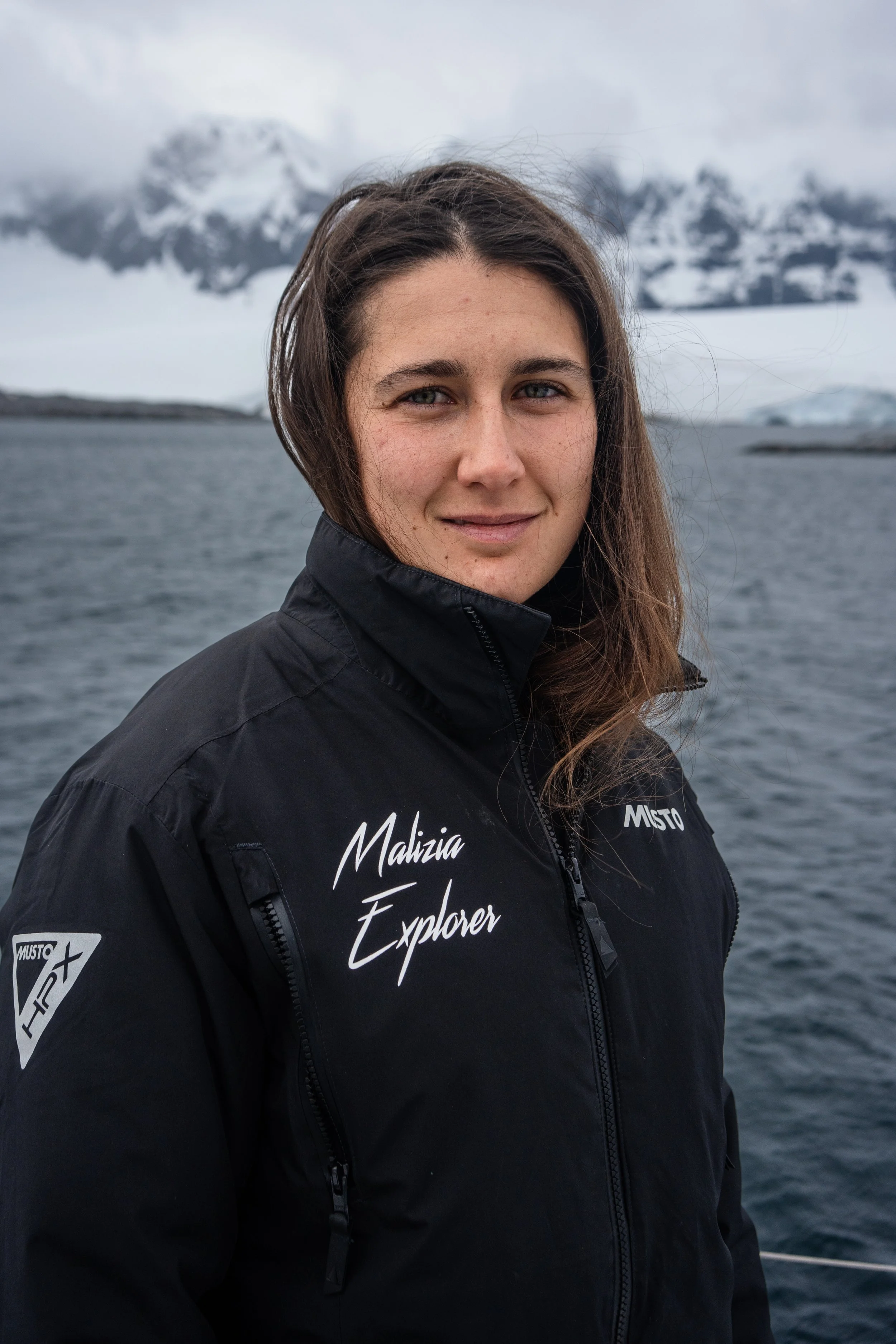
Juliette, we're sitting here on the Malizia Explorer, at the edge of the world or the center of the world. How does it feel to be here in Antarctica?
It’s pretty incredible to be here. It’s hard to really prepare for it or imagine how it’s going to feel before arriving. But yes, it’s a wonderful feeling to be in this very remote place, surrounded by wildlife. At the same time, being here as part of this incredible project and team, both on the Malizia and with Under The Pole, really adds to the experience. It’s both an exploration and a deeply human experience.
For those who don’t know you yet, who are you and what brought you all the way here?
My name is Juliette Jacquemont. I’m a postdoctoral researcher at the University of California, Santa Barbara. I’ve been working with Under The Pole for three years now on different campaigns across various ocean basins, and I’m here to help with the preparation, implementation, and analysis of scientific experiments.
I specialise in fish ecology and marine conservation science. I work with the expedition leaders, Emmanuelle and Ghislain (UTP), as well as with the divers to establish protocols to collect data and characterise marine animal forests in the mesophotic zone, which are the ecosystems at the heart of this decade-long program.
For anyone who isn’t deeply familiar with this project, what exactly does it mean to develop the protocols and research you just described?
The goal of this decade-long project is to characterise mesophotic ecosystems. These are ecosystems found below traditional scuba diving depths, so between 30 and 150 meters. Because they’re beyond conventional diving limits, they haven’t been well described yet.
Thanks to rebreather diving technology, which allows to dive down to over 100 m, divers working with Under The Pole can now explore and document these ecosystems. My role involves designing experiments to create standardised, comparable methods for describing these ecosystems. This allows us to compare them to shallow ecosystems, compare them across different regions of the world, and better understand their function and their link to other marine ecosystems.
Right now, everything around us looks grey and white. Is that what it looks like below the surface as well?
Below the surface, it looks strikingly different. Up here, we see shades of black, white, and blue. But underwater, especially in the mesophotic zone, it’s incredibly colorful.
In shallower waters, marine ecosystems are dominated by kelp forests, large green algae covering the seabed down to about 30 meters. Below that depth, where the divers are now exploring for the first time, the green kelp disappear because there’s less light, which they need to grow.
Instead, you find vibrant sponges, gorgonians, bryozoans, and many other benthic organisms. They’re bright yellow, orange, pink, it’s a completely different world, hard to imagine when you’re standing here on the surface.
How does your work here, so describing and characterising these ecosystems, connect to the larger mission of understanding and potentially protecting this region?
Science, conservation, and advocacy are deeply connected.
To raise awareness about the importance of protecting these ecosystems, we need to shed light on their diversity, vulnerability, and ecological functions. Showing images and revealing their beauty can motivate managers and conservationists to protect them and provide the information needed to protect them effectively.
Designing efficient conservation tools requires an understanding of how these ecosystems function: their spatial scale, how species diversity is distributed, and how they interact with other marine systems. This knowledge allows us to implement management strategies that appropriately protect them.
In practical terms, what would real protection look like here? What are possible pathways forward?
In the Antarctic Peninsula, there are currently no protected areas. This region is a unique bioregion within the Southern Ocean, with its own species and environmental conditions.
Global conservation targets aim to create representative networks of marine protected areas that include all major bioregions. The Antarctic Peninsula is currently not represented, despite being a biodiversity hotspot, a feeding and breeding ground for whales, and home to some of the highest biomasses and richest ecosystems of the Southern Ocean.
The goal is to implement a protected area known as “Domain 1.” It has been discussed for over ten years by Antarctic management bodies but has been delayed for various reasons. Our role is to support its implementation by bringing new data, scientific information, and awareness about these ecosystems.
Protection often feels local. How can protecting one region, like this one in Antarctica, create a ripple effect for ecosystems or communities far beyond this place?
In Antarctica, the connectivity across the global ocean is particularly clear. Many animals here travel across the globe. Whales, for example, migrate every year across multiple ocean basins.
Protecting krill populations here, which are a key food source for whales, supports whale populations that migrate worldwide and help them continue to thrive and to grow. That’s a very concrete example of how protecting one region can benefit ecosystems across the globe.