
Global Warning: The Urgent Case for Domain 1
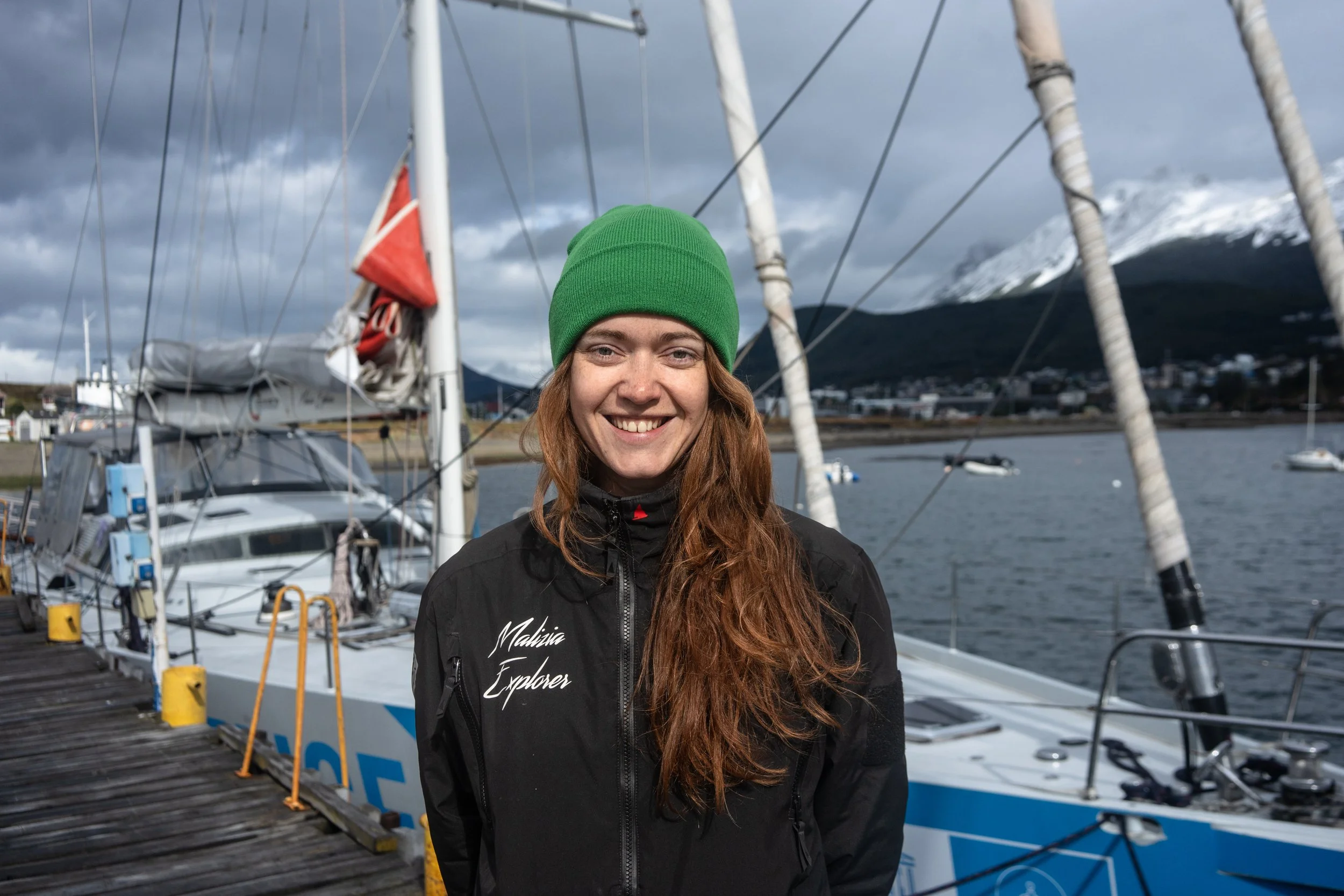
Anne-Sophie Roux is an ocean activist onboard the Malizia Explorer during the February leg of the joint mission with Under The Pole in Antarctica, and a leading voice in the “Global Warning” campaign advocating for the creation of a Marine Protected Area in Domain 1. During anchorage in Port Lockroy, we sat down with Anne-Sophie to discuss what it means to witness Antarctica firsthand, why protecting the Western Antarctic Peninsula is urgently needed, and how this remote region connects directly to the health of our global Ocean.
(scroll down to listen to the recorded version of the interview)
Sitting here right now, can you describe in a few words for people who aren’t here what you see, hear, feel, and smell?
Sitting right here, I see infinite shades of blue, whites and greys, and the immensity of the icebergs, as they’re truly impressive. I hear the wind, which is very strong today. And the smells are a mix of salt and penguin guano coming from the land nearby, where there’s a penguin colony.
You’re both an activist and now a firsthand witness to Antarctica. What responsibility comes with seeing this place with your own eyes?
Experiencing the ecosystem you’re trying to protect as an activist is very special. We often have a theoretical connection to ecosystems, but it’s completely different to experience them physically and to really feel them.
Being here as part of a collective, working with scientists, sailors, journalists, and activists, is also incredibly powerful. It helps us advance the work we need to do. We’re more efficient, we generate more ideas, and the campaign as a whole becomes stronger.
I also feel deeply privileged to be here under these conditions, with such an amazing team of experts, each with their own skills and expertise. It truly is a great privilege.
During this mission, we launched the petition to protect Domain 1. Why is protecting Domain 1 in the Western Antarctic Peninsula so urgent right now?
Across the entire continent of Antarctica, there are only two marine protected areas, so areas where fishing is restricted because they are particularly important and vulnerable to human impacts.
In the Antarctic peninsula, where we are, there are none. However, it is absolutely vital to the health of the Southern Ocean and the Southern Ocean itself is vital to the global ocean.
This region is especially important because it holds the highest concentrations of krill. Krill are tiny crustaceans, only a few millimeters to centimeters long, but they form the base of the Antarctic ecosystem. However, where there is krill, there is fishing activity as well.
We are trying to make this marine protected area a reality because the proposal for Domain 1 has been blocked for ten years - mainly by Norway, with support from China and Russia. And now it is more urgent than ever.
Environmentally, the ocean is approaching tipping points. We have a unique opportunity to act before irreversible damage occurs. Too often, we arrive too late and must deal with consequences. Here, we can act before that happens.
From a governance perspective, it’s also important to revive the spirit of the Antarctic Treaty. During the Cold War, amidst a very troubled geopolitical time, governments agreed to dedicate Antarctica to peace and science. Today, in another period of geopolitical tension, reviving that spirit of multilateralism, good governance, and science-based decision-making is incredibly important.
For people at home who may never see Antarctica, it can feel too remote to matter in daily life. How would you respond to that?
Antarctica and the Southern Ocean functions like the thermostat of our planet. We all depend on its health and stability.
Krill are linked to phytoplankton, microscopic algae that help produce the oxygen we breathe. These ecosystems also act as major carbon sinks and climate regulators.
In the face of the climate crisis, protecting places that still function as carbon sinks is vital. If we lose them, we risk crossing another tipping point, accelerating the climate crisis even further.
Antarctica is incredibly unique in its importance for all of us. And for once in our lifetime, we have the opportunity to act before it’s too late. That is rare and it is very important.
What can citizens do today to ensure Antarctica remains a natural reserve devoted to peace and science?
First, learn about it. Watch documentaries, follow sailors and explorers like those on the Malizia Explorer, read books, listen to podcasts. Understanding the beauty and fragility of Antarctica is the first step.
Then, support campaigns aimed at protecting it, such as the petition for Domain 1. This will likely be a long campaign, but public engagement is essential.
For governments, it’s crucial to play an active role in CCAMLR negotiations, which is the body responsible for marine protected areas and fisheries management around Antarctica. A minority of countries is currently blocking decisions about a place meant to be managed for the good of humanity.
Governments need to be proactive, defend Domain 1, and follow scientific recommendations. There is broad scientific consensus on the urgency of creating this marine protected area.
In today’s world, upholding multilateralism, international law, and good governance is more important than ever. Protecting Antarctica and Domain 1 is an opportunity to do exactly that.
You can read more about the campaign to protect Domain 1 here.