
looks like the Caribbean - But It Was Antarctica: Marine Animal Forests
© Marin Le Roux / PolaRYSE / Team Malizia
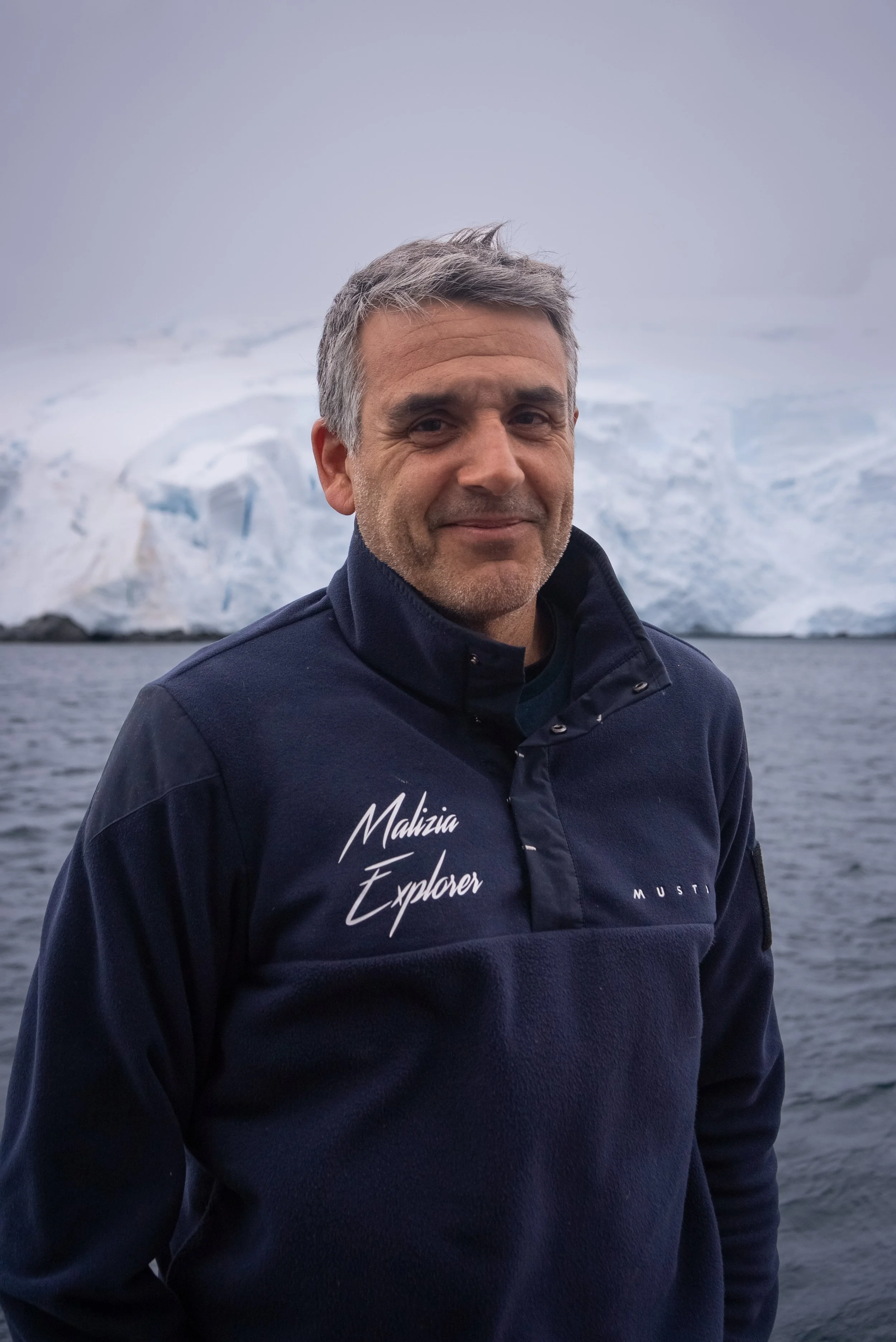
Francisco Otero Ferrer is a researcher onboard Malizia Explorer working on the joint Under The Pole mission in Antarctica. At the end of the mission, a few hours before arriving back in Ushuaia, we sit down with him to explore what these Marine Animal Forests in the mesophotic zone really are, dangers of diving at great depths in ANtarctica and how, beneath white ice and freezing waters, an unexpected forest of color and giants thrive in silence.
You’re a scientist, currently on board the Malizia Explorer, heading back to Ushuaia. You’re working on the mission with Under The Pole, exploring marine animal forests at depths of about 130 meters under the ocean surface in Antarctica.Can you tell us a bit more about yourself, your role, and your work?
I’m a researcher, but I’m also a technical diver. My role was to assist the team on land during the dives and to help develop scientific protocols, especially within our faculty and university.
We work on the epifauna of these marine animal forests. “Epifauna” refers to the small animals that live on these “animal trees.” Our goal is first to understand the biodiversity, essentially to identify and name species, and then to understand their relationships.
If we want to protect something, we have to understand how it works and functions. One important piece of the puzzle is understanding how biodiversity is linked to these marine animal forests.
We also hoped to study biochemical relationships between water currents and how the forest functions. Unfortunately, this particular marine animal forest wasn’t suitable for developing that specific protocol.
Let’s step back. On a very basic level, as most people don’t even know what a marine animal forest is. If you do not know about Marine Animal Forests, you most likely will not expect that beneath white-grey icebergs, vibrant colors of life exist. What is and what characterizes a marine animal forest?
Everyone knows what a forest is on land. If you ask a child what a forest is, they might say one tree, two trees, three trees. But actually, a forest is defined by its function: enough trees to create an environment. A big forest stops wind, provides shelter, holds seeds, insects, and creates life protected by its structure.
Under the sea, we find similar systems. You might think of seaweed or algae, but there’s another kind … a forest formed by animals. That’s something unique to the sea. You can’t find it on land.
These marine animal forests can be tall, short, and have many shapes. A coral reef is a classic example. It functions much like a terrestrial forest. But marine animal forests can also be formed by sponges, bryozoans, corals, ascidians, which are all many different animals that create tree-like structures underwater.
And what ecological functions do they have?
They provide shelter, habitat, and structure, just like terrestrial forests.
These forests can be formed by one species or many. We’ve studied marine animal forests globally, starting in Svalbard three years ago, then moving to the Canaries, the Mediterranean, the Caribbean, and now Antarctica.
I didn’t know what to expect in Antarctica. Surprisingly, it was similar to the Caribbean: colorful, diverse, full of shapes and species. That was unexpected.
In Svalbard, for example, the forest was dominated by one species, like a pine forest. But Antarctica was completely different: a mix of corals, sponges, bryozoans, ascidians… so it was very colorful, despite the low light at depth. When you arrive and switch on your lamp, it’s like: “Wow. Where am I? I’m in Antarctica, freezing cold, but it looks like the Caribbean!”
What were you actually doing day-to-day? You weren’t just diving to look around.
No, absolutely not. We didn’t have time for contemplation down there.
Dives at those depths are limited and carefully planned. For example, we developed devices, small chambers, that measure respiration and physiological function. We place these chambers over the “trees” at depth for 24 hours to measure how they breathe and build skeletons. These data help us understand ecosystem function.
We also observed polar gigantism. Some invertebrates, like Pycnogonida (sea spiders), that are only a few millimeters in temperate regions, were up to 30 cm large in Antarctica! It’s likely related to slow metabolism in cold water and high oxygen levels.
We saw sea stars with more than 15 arms. It felt like another planet.
How long were the dives?
On average, three hours.
For a 100-meter dive, you might spend 25-30 minutes working at depth. The rest, about two and a half hours, is decompression. Sometimes you wait one full hour at six meters. You can see the surface, see your colleagues on the zodiac, maybe even wave hello, but you cannot ascend. It’s an invisible wall.
It can be frustrating, but it’s also time to reflect. And sometimes penguins visit. Less pleasant is when an iceberg drifts toward you. A huge wall of ice coming your way. You must move carefully, as it can be quite dangerous.
You have to be actively calm in these situations.
Why not use ROVs (Remotely operated underwater vehicle) instead of divers to circumnavigate these dangers?
ROVs are complementary tools. They can collect samples and allow you to observe from the boat. But you lose the third dimension, which is spatial perception.
When placing instruments, to measure currents or other parameters or taken samples, experience matters. Being physically there helps you choose the best location and understand ecosystem function more precisely as well as see things you may have otherwise missed, if you had not been there.
And honestly, as long as diving is necessary, we’re happy to have an excuse to be there!
Now that the mission in Antarctica has concluded, what’s next?
The mission isn’t complete until the results are published.
We interacted with the environment, so even if we minimized impact, we still disturbed it somewhat. I feel a sort of moral obligation to publish our findings and make them available, for both scientists, managers, policymakers, and the public.
Until that happens, I feel I have a debt to this place.
As Team Malizia’s educational programme My Ocean Challenge, we invite kids virtually onboard to interact with the environment and learn more about the value of these distant ecosystems. You heard we were hosting an event in French, German, English, and you insisted we add Spanish, hosting 2 events yourself. Why is outreach important?
First: I was really happy to do it.
We had delays at the beginning of the mission, so our experimental work finished earlier than expected. I had time, and at some point, you can feel a bit useless just waiting.
Interacting with kids was different. You could see something awakening in their minds. We later received messages from teachers and parents saying their children couldn’t stop talking about it.
In a world that can sometimes feel hopeless, you realize you can make a difference, even on a small scale. It gives meaning to the work.
We should plan more of these. Reach more kids.
It's like planting seeds. You don’t know which ones will grow. Maybe years later, something will bloom. That gives me hope!
