
Baltic Sea Mission With Geomar
In July of 2026, several research expeditions led by the GEOMAR Helmholtz Centre for Ocean Research Kiel will set sail in the Baltic Sea aboard the research sailing vessel Malizia Explorer. The missions will focus on seagrass ecosystems and phytoplankton, two key components of the Baltic marine environment.
The joint mission will take place in the Kiel Bight, along Germany’s Baltic Sea coast and the coastal waters of southern Denmark. The research programme focuses on seagrass meadows and their role in blue carbon storage, as well as on phytoplankton and the impacts of anthropogenic pressures on Baltic Sea ecosystems.
Speakers at the event included offshore sailor Boris Herrmann, representing Malizia Explorer, and Prof. Dr. Katja Matthes, director of the GEOMAR.
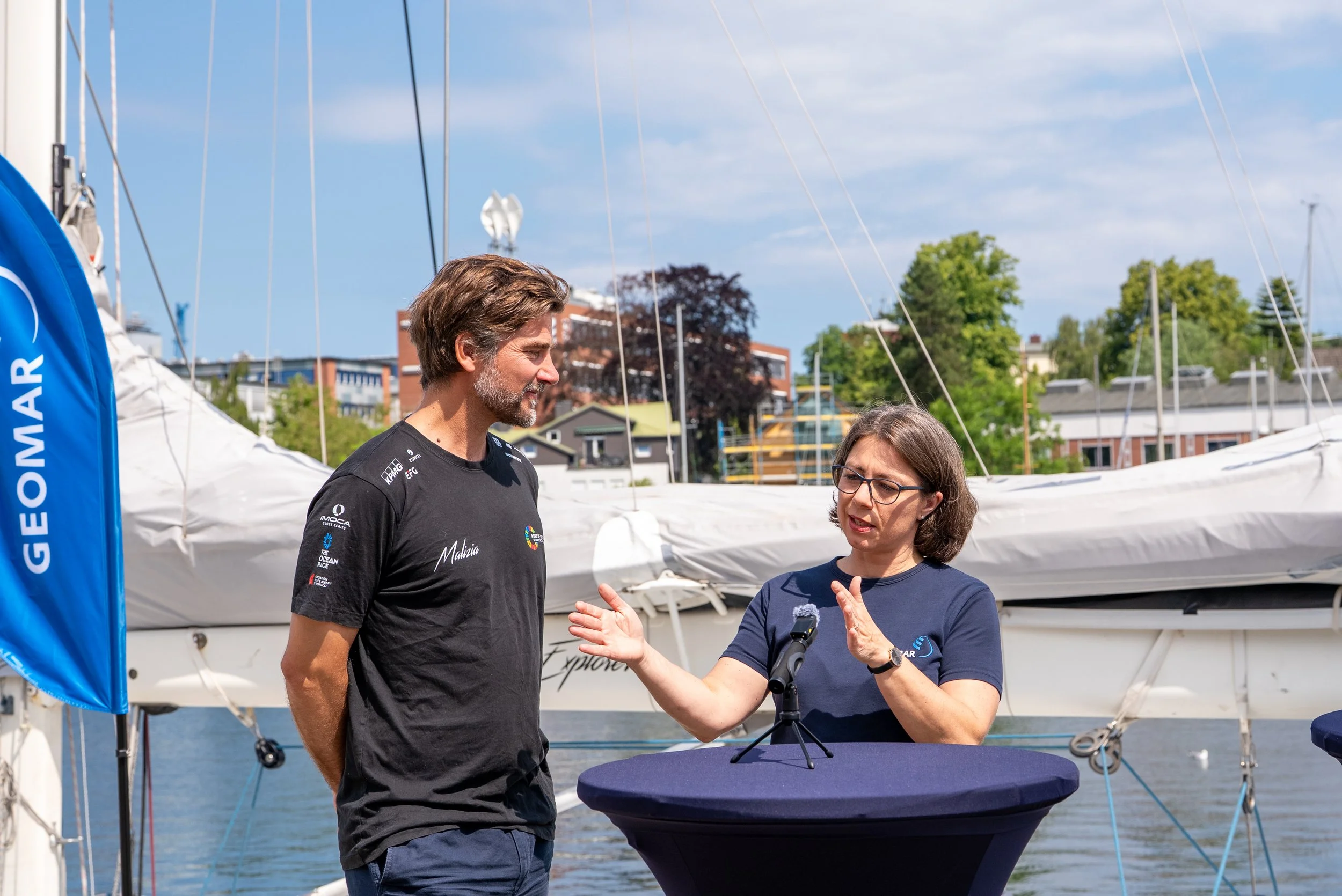
“The collaboration with Team Malizia combines outstanding research with a strong message for ocean protection,” said Prof. Dr. Katja Matthes, Director of GEOMAR. “With the Malizia Explorer, we can reach marine regions in a particularly climate-friendly way while also inspiring people about the importance of the ocean and the need to protect it.”
“I have been sailing the world’s oceans for many years and have witnessed the changes firsthand, most visibly the changes in the ice, but also the vast mats of sargassum that have begun forming across the Atlantic. Our collaboration with the scientific community evolved gradually. A researcher from GEOMAR collected data during a sailing race, and we wanted to do the same. Over the years, we came to understand why collecting data is both relevant and fascinating. That ultimately led to the idea for the Malizia Explorer,” Boris Herrmann explained, describing how the partnership between Team Malizia and GEOMAR came about.
A major focus of the expedition is the investigation of seagrass meadows, which serve as important habitats for marine life and can store significant amounts of carbon. Researchers will collect sediment cores to analyse existing carbon storage capacities and assess the blue carbon potential of seagrass ecosystems. Additional work will include genetic sampling to better understand the diversity and connectivity of seagrass populations, as well as environmental monitoring to identify local conditions and small-scale microclimates within the meadows.
The findings will contribute to a better understanding of how much carbon is already being stored in these habitats, which areas are particularly important for carbon sequestration, and where protection or restoration measures may be most effective in the future. The results will feed into Germany’s Action Programme for Natural Climate Protection (Aktionsprogramm Natürlicher Klimaschutz, ANK).
Beyond their role in climate mitigation, seagrass meadows are also a valuable indicator of coastal ecosystem health. They provide habitat, shelter and nursery grounds for a wide range of species, including fish, mussels and numerous invertebrates, making them an essential component of healthy coastal environments.
Another part of the research mission aims to improve our understanding of the Baltic Sea’s resilience to anthropogenic environmental pressures. Researchers will investigate the effects of climate change, eutrophication and oxygen depletion, all of which are placing increasing stress on the ecosystem.
Particular attention will be given to phytoplankton, which has been identified as one of the most important indicators for monitoring Ocean health and guiding restoration efforts. Despite its ecological significance, phytoplankton data remain limited in parts of the western Baltic Sea, making further research particularly valuable.
The Baltic Sea mission also highlights strong international scientific collaboration. The research is being conducted jointly by GEOMAR Helmholtz Centre for Ocean Research Kiel, Kiel University (Christian-Albrechts-Universität zu Kiel), and the University of Southern Denmark. Together, the partners aim to strengthen the scientific knowledge base for the German-Danish border region and improve understanding of the Baltic Sea, parts of which remain understudied despite being recognised as one of the most anthropogenically altered marine regions in the world.
The mission is set to commence in July.